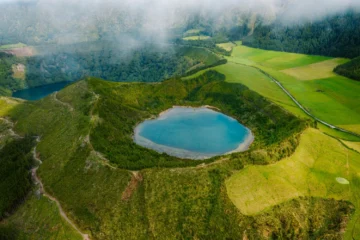
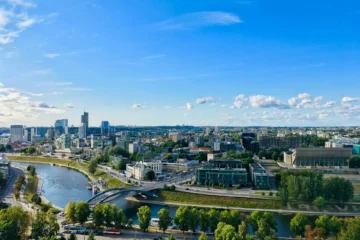
Montenegro is small. Really small. And yet, traveling through the country feels like exploring several different worlds in just a few days. Our journey takes us from the capital, Podgorica, to waterfalls, spectacular mountain landscapes and ancient monasteries, before heading to the Adriatic coast and the famous towns of Sveti Stefan, Budva and Kotor. And that is exactly what makes Montenegro so special: mountains, lakes and the sea are incredibly close together.
Starting in Podgorica
Our journey begins in Podgorica, the capital of Montenegro. Podgorica might not be the most spectacular city on our route, but it is a great starting point for discovering the country. The city is surrounded by mountains and crossed by several rivers. It also gives us our first taste of Montenegrin food and culture.
Traditional dishes include Njeguški pršut, a delicious air-dried ham, local cheeses, grilled meat, lamb, fresh fish and hearty dishes such as Kačamak and Cicvara.
Niagara Falls – Montenegro Style
Our next stop is one of Montenegro's more unusual attractions: the so-called Niagara Falls of Montenegro. Of course, these falls are nowhere near the size of the famous Niagara Falls in North America. But the name gives you an idea of the atmosphere. The falls are located on the Cijevna River, just outside Podgorica, and are especially impressive after periods of rain when the river carries plenty of water. It is a short stop, but a beautiful introduction to the natural side of Montenegro.
Ostrog Monastery – Built Into the Mountain
From the waterfall, we continue towards one of Montenegro's most famous landmarks: Ostrog Monastery. And this place is truly spectacular. The Orthodox monastery is built directly into a steep rock face high above the surrounding landscape. From a distance, it almost looks as if the monastery is growing out of the mountain. But Ostrog is much more than a tourist attraction. It is one of the most important Orthodox pilgrimage sites in the Balkans and is visited by thousands of pilgrims every year. The drive up to the monastery is an experience in itself, with increasingly impressive mountain views as you climb higher.
If you visit, remember that this is an active religious site, so respectful behavior and appropriate clothing are important.
Lake Skadar – Wild Montenegro
Next, we head towards Lake Skadar, the largest lake in the Balkans. This is where Montenegro shows another side of itself. Instead of busy streets and beaches, we find mountains, small villages, wetlands and huge open landscapes. Lake Skadar is also an important habitat for many bird species and is a great place to slow down for a while. One of the best ways to experience the lake is by boat. From the water, you get a completely different perspective of the surrounding mountains and untouched landscape.
If you're looking for the quieter, more natural side of Montenegro, this is the place to find it.
The Adriatic Coast – Sveti Stefan
After the mountains and the lake, we finally make our way towards the Adriatic Sea. And suddenly, everything changes. The landscape becomes Mediterranean, the air gets warmer and the blue of the Adriatic comes into view. One of the most famous sights on the Montenegrin coast is Sveti Stefan. The tiny fortified island, with its traditional stone houses and red roofs, is probably one of the most recognizable images of Montenegro. From the viewpoints above the coast, the scene looks almost unreal: the old stone buildings surrounded by deep blue water, with green hills rising behind them.
It's one of those places where you immediately understand why Montenegro has become such a popular destination.
Budva – Old Town Meets Beach Life
From Sveti Stefan, we continue to Budva, one of Montenegro's most famous coastal towns. Budva offers a little bit of everything: beaches, restaurants, nightlife and a beautiful historic old town. Inside the old city walls, narrow stone streets lead to small squares, historic churches and traditional buildings. But Budva is also one of the liveliest places on the Montenegrin coast, especially during the summer months. If you're looking for a quieter experience, explore the old town early in the morning or later in the afternoon.
And of course, when you're in Budva, a swim in the Adriatic is almost mandatory.
Kotor – Mountains, History and the Bay
Our next stop is Kotor. And this might be one of the highlights of the entire journey. The historic city sits directly on the spectacular Bay of Kotor, surrounded by enormous mountains. Even the drive into the bay is impressive. Inside the old town, narrow streets, stone buildings, churches and small squares reveal the area's Venetian influence. For a moment, it almost feels like you've arrived in Italy rather than Montenegro.
But Kotor isn't only impressive from street level.
Taking the Cable Car
One of the best experiences is the Kotor Cable Car. The cable car takes you from the coast up towards Mount Lovćen, covering around 3.9 kilometers and climbing more than 1,300 meters in elevation. And the ride takes only around 11 minutes. As the cable car climbs, the view becomes more and more spectacular.
- Travel duration: 1 week
- Best time to travel: May to September
- Main dish: 15 €
Book your activity**
Book your Accomodation*